Two homeowners can have driveways of almost identical size and receive quotations thousands of euro apart. It happens regularly, and understandably it leaves people wondering whether one price is too high, another suspiciously low, or whether there is such a thing as a normal driveway cost in Ireland at all.
The difficulty is that square metres only tell part of the story.
A flat 60m² entrance with a firm existing base and straightforward machinery access is one job. Put the same 60m² on sloping ground, add an old concrete surface that needs breaking out, water gathering beside the garage and a narrow entrance between two walls, and the amount of work changes before the new surface has even been chosen.
These are the sorts of questions homeowners ask all the time: why can two quotes be thousands apart, can an old entrance be resurfaced rather than replaced, and what is actually included in a square-metre price?
The answers usually become much clearer once you look at the property rather than the measurements alone.
What Actually Affects the Cost of a Driveway in Ireland?
The main things affecting driveway cost are the size and shape of the area, the condition of what is already there, the amount of groundwork required, drainage, access and the chosen surface. Borders and other finishing details can also make a noticeable difference.
It helps to think about an entrance in two parts. There is the finished surface everyone sees — SMA, tarmac, tar and chip, gravel, resin or pattern imprinted concrete — and there is the work needed to get the site ready for it.
On one property that preparation can be fairly straightforward. On another, a large part of the job may be completed before the finished material even arrives.
How Much Difference Does the Existing Ground Make?
You can often see the clues before anything is lifted. Dips in the wheel tracks, broken edges and several generations of patch repairs suggest a very different job from an entrance that has remained firm and level but simply looks worn.
The same applies when part of a front garden is being converted to parking. Grass and topsoil have to come out and a suitable base has to be constructed. An established entrance with sound foundations may need far less intervention.
Two areas can have identical measurements on paper and still require very different amounts of work.
Is It Cheaper to Resurface an Existing Driveway?
Resurfacing can be cheaper when the structure underneath is still sound. A worn top surface does not automatically mean everything underneath needs to come out.
That can sometimes be perfectly reasonable. Plenty of older Irish entrances have simply reached the stage where the surface is tired while the base remains serviceable.
Equally, repeated sinking in the same area is unlikely to disappear because fresh tarmac has been laid over it. Widespread movement, badly deteriorated edges or recurring drainage problems usually deserve a closer look before deciding whether resurfacing is enough.
Why Does Driveway Size Affect the Price per Square Metre?
Larger driveways cost more overall because they need more material and labour, but the price per square metre does not always increase in a straight line. Even a small job requires machinery, materials and a crew to get to site, so those fixed costs are being spread across a smaller area.
Shape matters as well. A broad rectangular entrance is generally simpler to work on than an area wrapping around a house, narrowing between pillars and opening out again beside a garage.
Curves, steps, planting beds and multiple edges all change the amount of finishing involved. Decorative borders are a good example: a straight run across the front of an entrance is quite different from carrying the same detail around curves and several parking areas.
How Much Does Access Affect Driveway Cost?
The smaller driveway is not automatically the simpler job.
A long rural entrance in County Meath or Kildare may cover a substantial area but offer plenty of room for an excavator, roller and delivery vehicles. A much smaller driveway in Dublin can be awkward if machinery has to operate between boundary walls, parked cars and a busy road.
Materials may have to be handled differently, and removing old material can take longer when there is little room to work. Access is one of those things that is difficult to account for accurately from measurements or photographs alone.
Why Can Drainage Add to the Cost of a Driveway?
After heavy rain, problem areas tend to identify themselves. Water sits between gate pillars, gathers along a garage threshold or keeps returning to the same low point long after the rest of the entrance has dried.
Sloping sites bring their own issues. Water coming down from higher ground can move quickly across an entrance and needs somewhere suitable to go.
If there is already an obvious water problem, resurfacing is a good time to address it. That may involve adjusting levels or adding appropriate drainage rather than simply putting a fresh surface over the same low spot.
There is no need to turn every driveway into a drainage engineering exercise, but ignoring water that is already causing trouble rarely improves matters.
Does the County You Live in Change Driveway Cost?
Location can affect the price, although the county itself is rarely the deciding factor. The type of property, access and amount of work involved matter far more.
Take County Kildare. A newer detached home around Naas or Newbridge might already have a well-established entrance with easy road access. If the base is in reasonable condition, the work could be largely about resurfacing and finishing.
A rural property in County Westmeath may have a much longer approach, different drainage requirements and regular use by trailers or heavier vehicles. The overall area alone could be several times larger.
Neither county is inherently a “cheap” or “expensive” place to install a driveway. The properties simply present different jobs.
How Much Difference Does the Driveway Material Make?
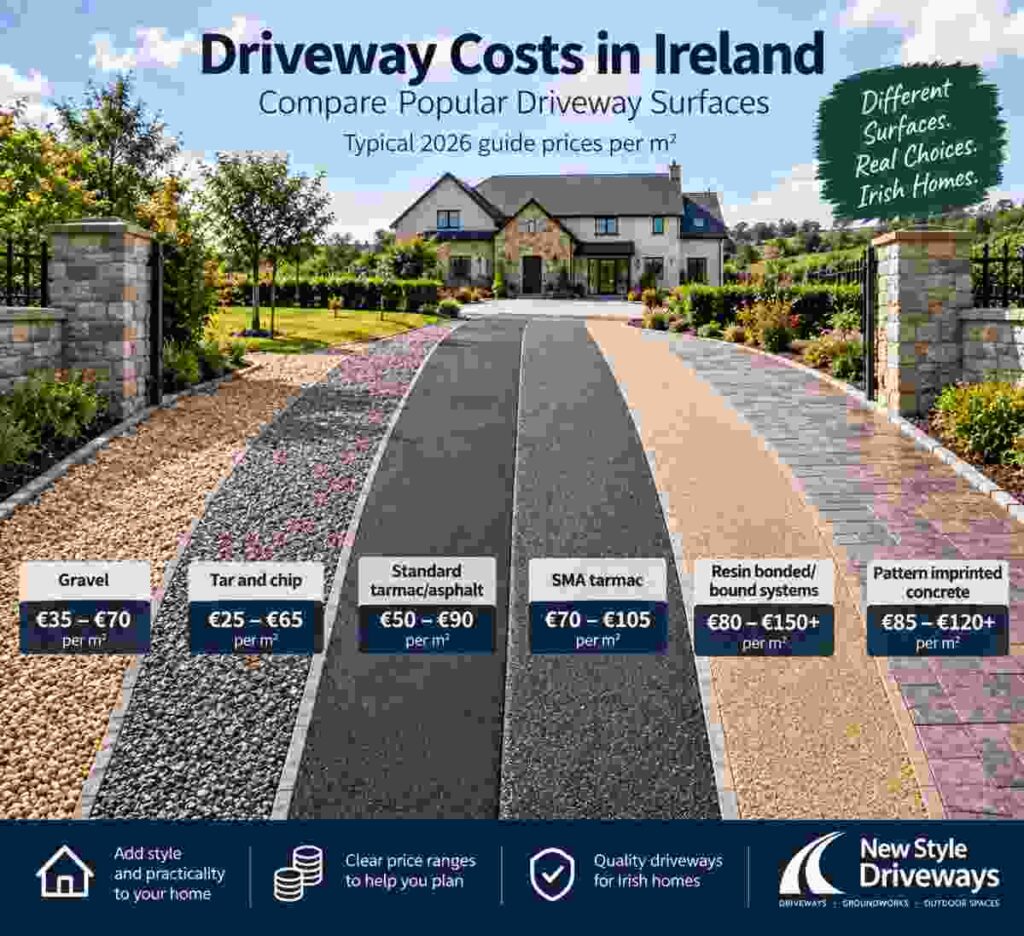
The material remains a significant part of the budget. Gravel and tar and chip generally sit towards the more economical end, standard tarmac and SMA occupy the middle, while resin and decorative concrete tend to cost more.
The following figures are useful 2026 budgeting ranges rather than site-specific quotations.
| Driveway material | Typical 2026 guide price per m² |
|---|---|
| Gravel | €35–€70 |
| Tar and chip | €25–€65 |
| Standard tarmac/asphalt | €50–€90 |
| SMA tarmac | €70–€105 |
| Resin bonded/bound systems | €80–€150+ |
| Pattern imprinted concrete | €85–€120+ |
Material choice often follows the property. Gravel can make good sense across a long country approach where covering a large area in a decorative finish would be difficult to justify. SMA suits many busy residential entrances, while tar and chip offers a fixed surface that sits comfortably in rural settings. Resin and pattern imprinted concrete tend to come into consideration where the finished appearance is a larger part of the brief.
There is no benefit in paying for a particular material simply because it costs more. It has to make sense for the site.
Do Borders, Kerbs and Entrance Details Make Much Difference?
Borders and kerbs can add noticeably to a quotation because both the materials and the labour have to be allowed for. Granite setts, contrasting block borders, decorative kerbing and curved layouts all involve more work than finishing a simple straight edge.
Used with restraint, they can be worthwhile. A granite or block border can finish an SMA or tarmac entrance neatly and tie it into existing paths, walls or gate pillars. On a long rural entrance, simpler edging may look better and keep the cost sensible.
There are less obvious details too. Manholes sometimes need adjusting to the finished level, existing kerbs may need replacing and old concrete edging may have to come out.
These are small items individually, but on a larger project they add up.
Why Are Some Driveway Quotes So Far Apart?
Two quotations that appear to be for the same driveway may actually cover quite different amounts of work. One might include excavation, repairs to the base, drainage and new edging, while another is mainly pricing a new surface over what is already there.
A homeowner looking at quotations of €5,700 and €8,500 for what seems like a fairly modest tarmac job might naturally ask which price is right. That is probably the better question to ask: what exactly is different between the two proposals?
Before comparing the figure at the bottom, check whether both quotations cover the same job. How much is being excavated? Is the existing base staying? What edging is included? Is there drainage work? Who removes the old material?
Often the difference becomes fairly obvious once the actual work is compared side by side.
Is Gravel Really the Cheapest Way to Do a Driveway?
Gravel is generally among the lower-cost driveway options, particularly where a suitable base already exists. That does not make it a temporary or inferior choice.
For a long rural property, gravel can be entirely sensible and may remain there permanently. Other homeowners use it for a period before eventually moving to tarmac, SMA or another fixed surface.
There is some maintenance. Stone moves under tyres, occasional topping up may be needed and steep entrances can be troublesome if gravel continually travels towards the road.
There is no rule saying every driveway has to end up in tarmac or resin.
Does Choosing the Cheapest Quote Save Money?
A lower quotation can represent perfectly good value when the scope and specification are comparable. The important thing is knowing whether you are comparing like with like.
If one contractor proposes keeping a sound existing base and another wants to excavate the entire entrance, ask why. There may be a sensible reason for either approach, depending on what they have found on site.
The figure itself only becomes useful once you understand what has been allowed for.
What Should You Ask During a Driveway Site Visit?
It does not need to become a technical interrogation.
Ask whether the current base can stay. Show the contractor where water gathers after rain and mention any area that has sunk previously. If delivery vans, trailers, horseboxes or other heavier vehicles regularly use the entrance, say so.
Those details matter because the conversation should reflect the property.
For a family home in Kildare, the priorities may be several cars, easy day-to-day maintenance and a tidy entrance. On a rural property in Westmeath, the discussion might be about a much longer approach, heavier traffic and keeping the specification sensible across a larger area.
What Is the Biggest Factor Affecting Driveway Cost in Ireland?
There is no single factor that determines every driveway price, but the work required before the finished surface is laid is often one of the biggest variables.
That is why asking “How much is tarmac per square metre?” only gets you so far.
A better question is, “What needs to be done to this entrance before the tarmac goes down?”
Once that has been established, the driveway installation cost becomes much easier to understand.
New Style Driveways works across tarmac, SMA, tar and chip, gravel, resin and concrete finishes, along with the groundwork, drainage and edging that often determine how well the finished driveway performs.
A site visit allows the actual conditions to be assessed before deciding what work — and what level of spending — the property really needs.