There is a particular moment familiar to anyone living in the Irish countryside. You turn in through the gates after a week of rain and immediately know whether the entrance was built properly or not.
Water gathers in the same hollow near the pillars. Gravel migrates into the lawn again. Moss thickens along the shaded wall. The left edge starts to soften where delivery vans insist on cutting the corner. By February, the whole thing feels slightly tired.
In County Meath, where homes range from long farm lanes outside Kells to neat suburban estates around Ashbourne and Dunboyne, entrances take a surprising amount of punishment. Irish weather sees to that quickly enough.
And yet, a well-finished approach changes a property entirely.
Not in the glossy brochure sense of the word. More quietly than that.
A good surface settles naturally into the house around it. It suits the walls, the gates, the garden, the age of the property. It survives wet winters without looking exhausted by spring. It manages water properly. It does not demand constant patching every few years.
That, increasingly, is what homeowners across Meath are looking for now — not simply something new, but something that feels suited to the property and capable of lasting in Irish conditions.
TL:DR – Things Homeowners in Meath Should Know Before Resurfacing an Entrance
- Long entrances often need stronger preparation than homeowners expect, especially on softer rural ground.
- Tar & chip remains one of the most practical choices for larger country properties.
- SMA surfacing has become increasingly popular for homes that want a cleaner, quieter finish.
- Resin can look beautiful in the right setting, though it tends to suit sheltered or shorter approaches best.
- Drainage matters far more than most people realise — particularly near gates, slopes, and shaded areas.
- Moss, standing water, and crumbling edges are usually signs of poor water management underneath rather than surface wear alone.
- Costs vary hugely depending on excavation work, access, and how much preparation the existing ground needs.
- The entrances that age best are rarely the most expensive ones. They are usually the ones designed properly from the beginning.
The Quiet Shift Happening Around County Meath Homes
Over the past few years, there has been a noticeable change in the kind of resurfacing work homeowners are asking for.
The older approach — laying something quickly over an uneven base and hoping for the best — has become harder to justify. Winters are wetter. Vehicles are heavier. Homes receive more deliveries than they did ten years ago. Many entrances now deal with vans, SUVs, trailers, horseboxes, and farm traffic regularly enough.
Even suburban properties around Navan or Ratoath see far more wear than they once did.
As a result, Meath driveway contractors are finding that homeowners ask different questions now. Less about appearances alone. More about drainage, lifespan, maintenance, and whether a surface will still look respectable after five or six Irish winters.
The answers often depend less on the visible finish and more on what sits underneath it.
Poor preparation nearly always reveals itself eventually. Usually beside gates first. Or where water naturally gathers after heavy rain.
Surfaces That Sit Naturally in the Irish Landscape
Some finishes simply belong more comfortably in Irish settings than others.
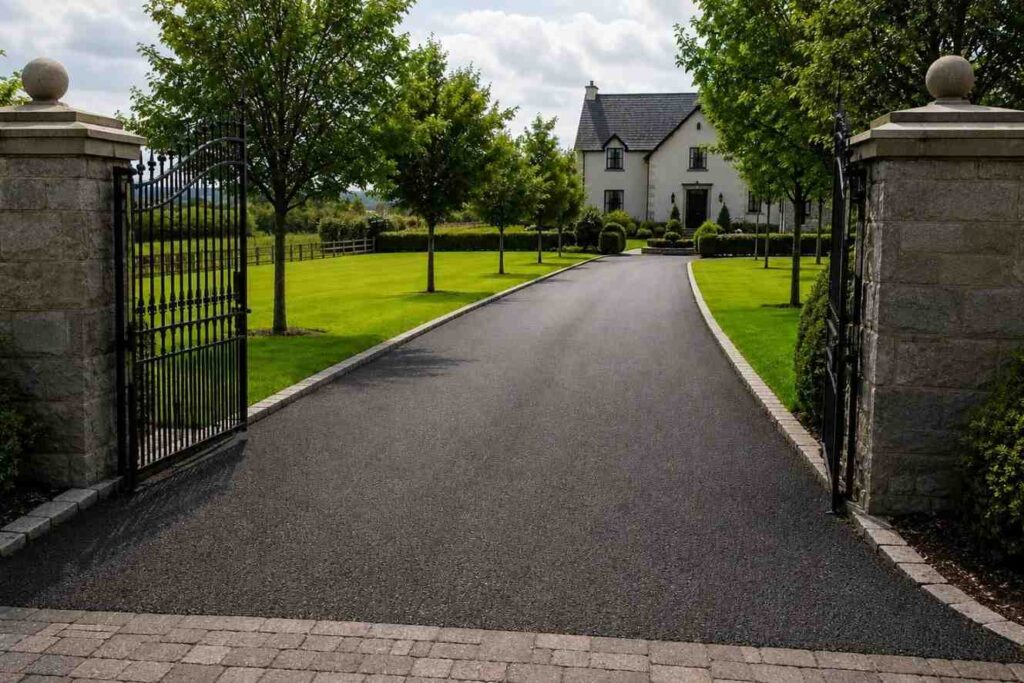
Tar & chip remains one of the most common choices for rural homes throughout County Meath, particularly on longer entrances where loose gravel would become a constant nuisance. It has a softer, settled appearance that works well beside stone walls, mature trees, and older properties. It also avoids the slightly harsh look that highly polished surfaces can sometimes create in the countryside.
And there is practicality to it too.
Anyone who has lived with loose gravel long enough knows the routine: stones dragged into the house, scattered into flowerbeds, gathering at the bottom of slopes after rain. Tar & chip keeps much of that character without the endless migration across the garden.
For many homes, particularly outside Trim, Athboy, or Oldcastle, it feels entirely appropriate.
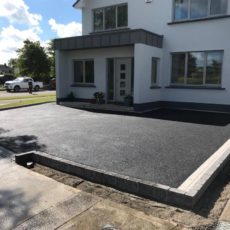
SMA driveways, meanwhile, have become increasingly common around newer homes and renovated properties across Meath. The finish is cleaner and visually calmer than traditional tarmac, with a textured surface that handles wet weather particularly well.
It suits:
- modern extensions
- contemporary rural homes
- suburban properties
- entrances with electric gates
- homes with more formal landscaping
Without feeling overly styled.
That balance matters.
The best entrances rarely dominate the property itself. They simply make the whole place feel more complete.
Choosing a Surface That Can Handle Irish Rain
Irish weather has a way of exposing weak spots quickly.
An entrance may appear perfectly finished in July, only for problems to emerge by the first difficult winter. Water begins sitting near the entrance after heavy rain. The edges soften. Fine cracks appear where freezing temperatures catch trapped moisture underneath.
This is particularly common on older resurfacing work where fresh material has simply been laid over unstable ground.
In County Meath, drainage tends to matter more than homeowners initially expect. Long country entrances often channel water downhill naturally, while suburban properties can struggle where paving meets footpaths or garage entrances.
The troublesome areas are usually predictable enough:
- near gates
- beside drains
- at the bottom of slopes
- under overhanging trees
- along shaded walls where moss never fully dries
Resin surfacing can work beautifully here when conditions suit it. On shorter, well-drained approaches, particularly around landscaped gardens or newer homes, resin gives a clean finish that remains visually soft rather than stark.
But not every property needs resin.
Nor does every property suit it.
Long rural lanes with heavy trailer traffic may benefit far more from SMA or asphalt. Equally, some traditional farmhouses simply look better with a textured chip finish that feels more natural against the surrounding landscape.
The surface should suit the property, not compete with it.
What Homeowners Are Really Paying For
The visible surface is only part of the cost of resurfacing work.
What changes pricing dramatically in County Meath is usually the condition underneath.
A relatively straightforward entrance in a suburban estate may need minimal excavation and fresh edging only. A long rural access road outside Kells or Slane may require extensive drainage work, deeper stone foundations, and machinery access before the final surfacing even begins.
That is why prices vary so widely.
As a rough guide:
- tar & chip often starts around €45 per m²
- SMA and asphalt generally range from €70–€100 per m²
- resin systems can rise beyond that depending on finish and preparation work
But those figures only tell part of the story.
A badly prepared entrance resurfaced cheaply often ends up costing more over time than a properly finished job completed once.
Most homeowners eventually learn that lesson around the third repair visit.
The Questions Homeowners Tend to Ask After a Few Winters
One question comes up repeatedly across both rural and suburban properties:
“How long should this realistically last?”
In Irish conditions, a properly prepared and professionally installed surface can last decades. But longevity depends heavily on water management and traffic levels. A quiet residential entrance behaves very differently from a long country lane carrying trailers, deliveries, livestock traffic, and daily family use.
Another common concern is maintenance.
In reality, most modern surfacing requires very little attention once installed correctly. Problems usually arise where water has been allowed settle repeatedly or where edges were left unsupported from the beginning.
Moss is another familiar issue in Meath gardens, especially near mature hedging or north-facing walls where winter sunlight barely reaches the ground. No surface completely escapes it. Some simply disguise it better than others.
And then there is gravel.
Nearly everyone who replaces loose gravel says the same thing afterwards:
they wish they had done it years earlier.
Why Some Entrances Always Look Better with Age
The entrances that hold up best in County Meath are rarely the flashiest.
Usually, they are the quieter ones.
The surfaces that suit the scale of the house. The finishes that sit naturally beside old stonework or newer planting. The entrances where water disappears properly after rain instead of lingering for days near the gateposts.
There is often restraint to good resurfacing work.
Too much contrast can look forced. Overly decorative finishes can date surprisingly quickly. Simpler materials, installed properly, tend to settle more comfortably into Irish properties over time.
That applies equally to village homes in Enfield, farmhouses outside Trim, or suburban estates around Navan.
The principles remain remarkably similar:
good drainage, solid preparation, suitable materials, and a finish that makes sense for the property itself.
New Style Driveways works with homeowners across County Meath on SMA, tar & chip, resin, asphalt, and decorative driveway projects designed for Irish weather conditions.
And in most cases, the entrances that age best are the ones built around proper preparation, sensible drainage, and materials suited to the house itself — not simply whichever finish looked best in the brochure.
So give us a call today and we’ll give you a quote.